Posts

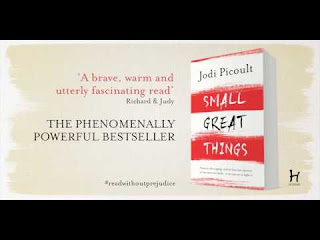
Small Great Things

Image
Got excited when I got my hands on this one. However, my first impression was disappointment. I almost stopped reading when an example of racism given was a lady picking up her purse after catching someone approaching from the corner of her eye. I've done that before, movement in my eye reminding me I should be paying attention to my purse to discover it's my husband. I found it to be the only misplaced example in the whole book. Cause the rest of this book is breathtaking in terms of how the author frames three different stories: Nurse Ruth, a White supremacist and the nurse's lawyer. Now I understand that that moment of assumption, any assumption on both sides is the point the author was making. To know more, read it ;-) I don't want to give anything away. I hope it's enough to say the book is written well and held my attention throughout, once I got beyond the one example mentioned above. It's also an important book for the topics it raises and asks o...

Hamnet by Maggie O'Farrell: fleeting & beautful

Image
In describing the theme of the book Waterstones says: One of our greatest living novelists resurrects the short life of Hamnet Shakespeare, in this lyrically written and emotionally devastating account of the Bard’s only son. Utterly immersive and convincing, Hamnet is a poignant period tale that not only shines a light on an oft-neglected area of Shakespearean history but speaks to wider themes of grief and loss with impeccable poise and unflinching honesty. The words “speaks to wider themes” I connected to the fact that a single piece of writing can awaken many impressions within us. Reading Hamnet I was reminded of the words of another writer below: “No single event can awaken within us a stranger whose existence we had never suspected. To live is to be slowly born.” Antoine de Saint Exupéry (1900-1944). His point, according to Bodhipaksa , was that these awakenings are not random, they come from somewhere. A chain of cause and effect. I feel that w...

The hippopotamus by Stephen Fry

Image
  Surprised I managed to finish it, what with juggling work and writing and some time for relaxation and mental health, but this month I read the above novel. And I am struck by the characterisation of The hippopotamus, and thus delved deeper into Stephen Fry’s writing psyche. But not that deepily; at least, not to the depths of a hippo with a cocktail on its nose. The main character of the book is poet and newspaper columnist (and hippo), Ted Wallace. It’s clear from the initial scene that he’s got an inflated sense of self importance as he gets fired and goes to stay with relatives. I had just been sacked from my paper, some frantic piffle about shouting insults from the stalls at first night. I love these creative descriptions of his editor, that, note, also describe his contempt: my wet turd of an editor had shrilled the kind of anile little runt who, in foyers and theatre bars the West End over, can be heard bleating into their gin and tonics I ...

Writing in turbulent times (unedited thoughts of a writer)

Image
Post-Brexit, coronavirus, whatever the current political or global crisis writers keep writing. Don't they? Not always. During 9/11 it has been noted that creativity took a nosedive... okay, I'm going to be honest here... I couldn't find my original reference. Some years ago I read something related to something. Just kidding. I read an article related to trauma and it discussed that when 9/11 happened writer productivity/submissions to publishers fell. Apparently everyone was too shocked to write. As that would require some semblance of normalcy. Please tell me if you find this article back as I would love to reread it. Anyhow, now my thinking has changed. A lot has also happened in my life since 9/11, my student days, when I worked part-time as a cleaner to pay my way through university. Not to mention, the fallout from 9/11 such as increased airport security and the hoops we now must jump through. Sigh. On a more optimistic slant, I have discovered living in the ...